
Most teams outgrow Pega when customization costs spike and model updates lag behind new compliance rules. The gap shows up first in audit trails that break during upgrades and in agents that cannot read the latest policy PDFs. Replacing the platform demands a checklist of three concrete criteria: native document control, workflow orchestration that logs every step, and an AI agent that stays current without manual retraining.
By the final section you will know how Process Street, Appian, and one other option each meet or miss those criteria, plus a short decision tree that points to a single best fit for your process library and risk register.
What to Look For in AI-Powered Process Automation Platforms
Selecting an AI-powered process automation platform requires evaluating six core capabilities that determine long-term scalability and compliance.
AI governance controls form the foundation of any enterprise system. Audit trails track every change to workflows and data, while role-based permissions limit access to authorized users only. These features help organizations meet regulatory requirements and reduce risk.
Integration depth matters when connecting to existing ERP and CRM systems. Pre-built connectors speed up setup, but REST APIs provide flexibility for custom needs. Organizations should confirm compatibility with their current technology stack before committing.
Low-code and no-code builders let non-developers create and modify workflows. Drag-and-drop interfaces and visual rule editors reduce dependence on IT teams. This approach speeds up deployment and supports business agility.
Real-time decision automation uses predictive and prescriptive analytics to guide processes. Machine learning models analyze patterns and recommend next steps, while prescriptive tools suggest optimal actions. These capabilities improve consistency across operations.
Cloud deployment options and data residency choices affect compliance and performance. Organizations may require specific regional hosting to meet local regulations. Flexible infrastructure helps teams scale resources as demand changes.
Vendor certifications such as SOC 2 Type II and ISO 27001 demonstrate security standards. Independent audits validate controls around data protection and system reliability. These credentials provide assurance when handling sensitive business information.
1. Process Street - Best Overall
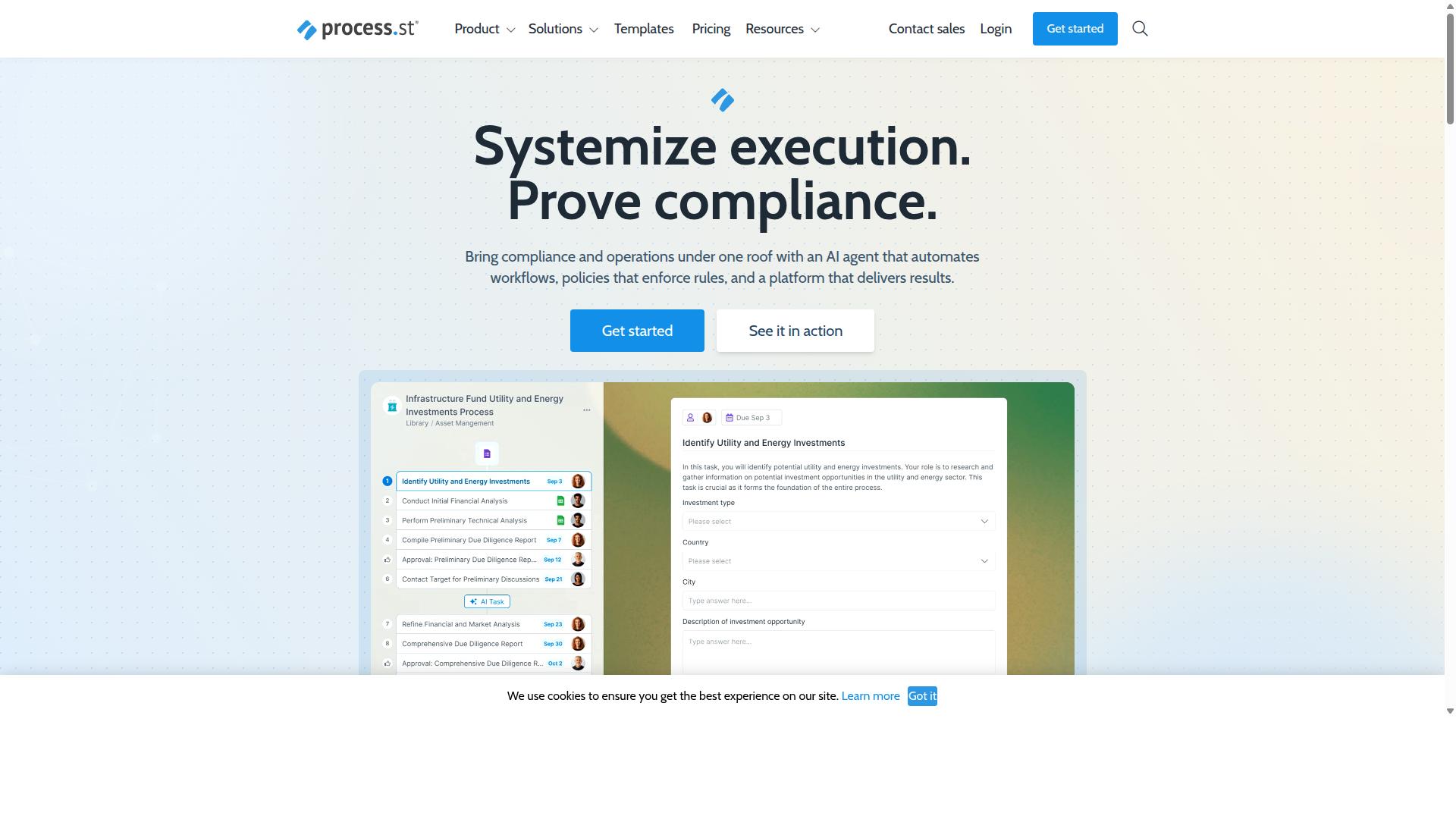
Process Street earned the top spot for midsize and enterprise teams that need both process orchestration and audit-ready documentation.
The platform combines document control with workflow automation, creating a unified environment for compliance and operations. Teams gain centralized oversight while reducing manual handoffs between policy creation and execution.
Process Street supports SOC 2 Type II and ISO 27001 certifications, addressing enterprise security needs without requiring separate compliance tools. Organizations choose it when they want one system to manage both documentation and operational workflows.
IMCD UK reported 75 percent reduction in setup time after adopting the platform. More than 3,000 companies now use Process Street to standardize processes across departments and regions.
Docs: Document & Policy Control
Docs centralizes policy storage, version control, and approval workflows under a single compliance layer.
The system enforces ISO 9001, SOC 2, SOX, and FDA requirements through structured governance controls. Automatic change tracking maintains a complete audit trail for every document revision.
Role-based access determines who can view, edit, or approve content. This structure prevents unauthorized changes while keeping policies accessible to the right stakeholders.
Teams working with Pega alternatives often need tighter document governance than Pega Infinity provides. Docs delivers that control without requiring extensive configuration.
Ops: Workflow Automation & AI Orchestration
Ops converts policy documents into AI-assisted, repeatable workflows that trigger tasks and approvals automatically.
The flow begins when users upload a policy, which the system then transforms into workflow tasks. Owners receive assignments with deadlines, and progress updates appear in real time.
AI suggestions help teams identify next steps based on existing process patterns. This automation reduces the manual coordination typically required when moving from policy to execution.
Organizations replacing Pega BPM often seek simpler workflow creation. Ops provides that simplicity while maintaining the structured approach enterprise teams require.
Pricing Overview
Three tiered plans scale from early-stage teams to global enterprises requiring advanced governance.
The Startup plan includes 5 users, 10 guests, and 100 automation actions per month. Pro plan offers unlimited users and guests with 10,000 Data Set records available.
Enterprise customers receive custom automations, SSO integration, and a dedicated success manager. This structure lets organizations match their investment to actual usage and compliance needs.
Teams evaluating Pega AI alternatives can start with the 14-day Pro trial without providing payment details. The plan flexibility supports growth from startup through enterprise scale.
2. Appian
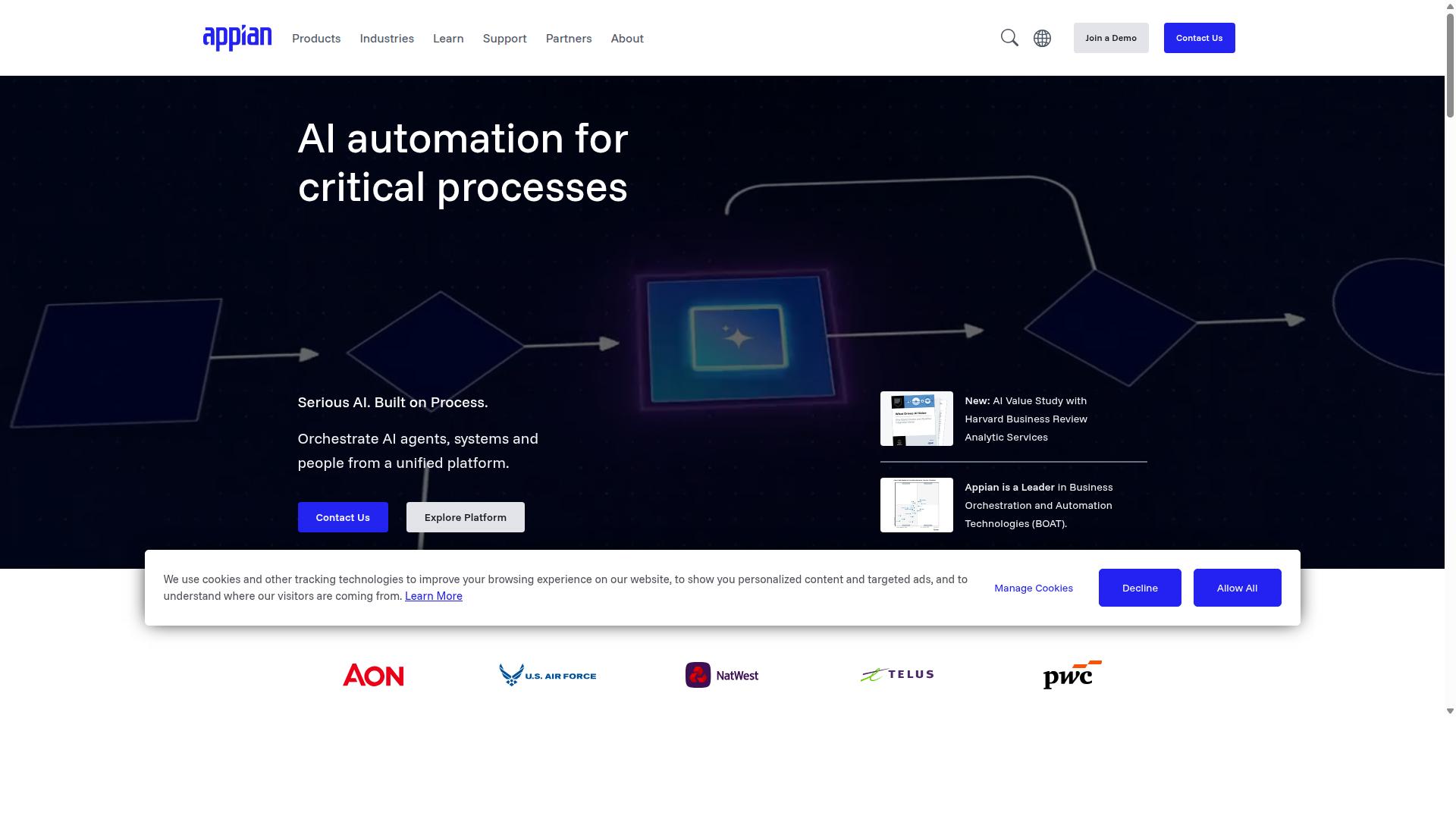
Appian provides a low-code case-management platform with strong BPMN modeling and decisioning tools. The platform combines design, automation, and optimization functions within a single environment. Teams use these capabilities to build and refine business processes across multiple departments.
Built-in BPMN designer tools let users map workflows using standard notation. The interface supports both simple sequences and complex branching logic. Process diagrams remain easy to update when business requirements change.
Low-code forms speed up data collection without requiring extensive development. Users drag and drop elements to create input screens that feed directly into automated steps. These forms adapt to different screen sizes and user roles.
Decision rules help organizations standardize choices across similar cases. Teams define conditions once, then apply them to new records automatically. This approach reduces manual review time and improves consistency.
Specific pricing and performance data vary by deployment. Organizations should request current details from the vendor to match their scale and requirements. Appian serves financial services, insurance, government, and manufacturing sectors with packaged solutions for contract management, claims processing, and enterprise modernization.
How to Choose the Right Option
Match platform selection to departmental needs, data-residency requirements, and existing tech stack.
Start by confirming the compliance frameworks your organization must satisfy. Teams in financial services, healthcare, and capital markets often require ISO 9001 or SOC 2 certification.
Map these requirements against each vendor's certifications before moving forward. This step prevents costly platform changes later.
Next, identify who will interact with the system. Define internal roles such as operations, compliance, human resources, or finance. Determine whether external parties need guest access for client onboarding or document review.
Clear role definitions help select platforms that provide appropriate permission controls without overprovisioning access.
Regional data-residency options come third. Organizations in regulated industries must verify that data stays within approved jurisdictions.
Review each platform's hosting locations to confirm compliance with local storage laws. This verification protects against regulatory penalties.
Finally, calculate estimated automation actions per month. Compare these projections against plan limits for the platforms under consideration.
Accurate volume estimates ensure you select a tier that accommodates growth without unexpected overage charges. This calculation also reveals which platforms scale cost-effectively for your specific workload.
Final Verdict
Process Street delivers the strongest combination of compliance documentation and AI-assisted workflow execution for teams already operating under regulated frameworks.
Teams evaluating advanced AI platforms typically focus on three standout metrics. Process Street offers 30% faster documentation compared to traditional approaches, which helps regulated teams maintain audit readiness without sacrificing speed.
Setup efficiency also matters when replacing or augmenting legacy systems. Customers report a 75% reduction in setup time after adopting the platform, reducing project risk and accelerating time to value.
Standardization across large organizations remains challenging for legacy BPM tools. Process Street already supports 49k+ employees standardized onboarding, showing the platform can scale while preserving consistency in complex environments.
Buyers should still run a proof-of-concept tailored to their specific process complexity. Each organization faces unique regulatory requirements and integration needs that no single metric can fully capture. Testing the platform against actual workflows provides the clearest picture of fit.
Recommended Resources: